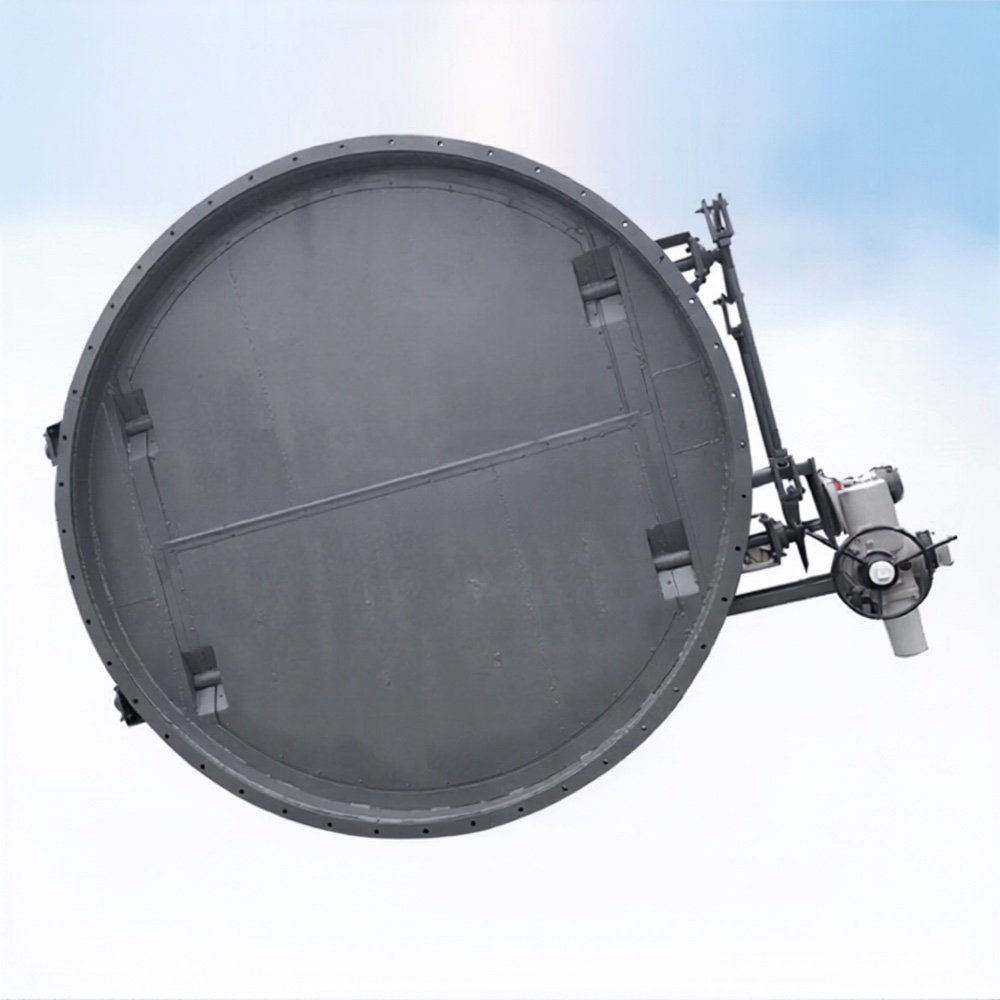
Double Louvre Damper Gate
Twin-row louvre gate with sealing air between the blade banks — 99.9 % sealing efficiency and pressure loss below 50 Pa when open.

Fourteen product families covering every isolation and regulating position between the boiler outlet and the stack. Standard ranges in stock sizes, everything else built to your drawing.
Heavy-duty isolation gates for boiler flue ducts, with single or double blade rows.
Double louvre gas dampers with sealing air, designed for zero-leakage duty.
Regulating and shut-off dampers for cold and hot air ducts with linear characteristics.
Corrosion-resistant gates for wet FGD inlet, outlet and bypass service.
Circular isolation and throttling dampers for round air and flue ducts.
Rectangular multi-blade dampers for large air ducts and rectangular flue runs.
Guillotine-type gates that give a physical, visible break in the gas path.
Light-duty flap dampers for low-pressure air and dust-laden gas lines.
Abrasion-resistant gates for coal bunkers, feeders and pulverizer outlets.
Compact blade valves for tight shut-off on small and medium ducts.
Saddle-seat slide gates with hard and soft sealing for dust-laden ducts.
Zero-leakage valves for isolating gas and air branches during maintenance.
Rising-spindle gate valves for isolating dust and ash handling lines.
Variable and constant spring supports, rigid hangers and sliding supports for ductwork.
Twin-row louvre gate with sealing air between the blade banks — 99.9 % sealing efficiency and pressure loss below 50 Pa when open.
Louvre-type gate for flue gas desulfurization systems, supplied as single-blade or zero-leak double-blade with sealing air.
Two parallel blade shafts linked by tie rods, driven by electric actuators — built for very large rectangular flue sections.
Linear-characteristic regulating damper for cold and hot air ducts, with ball-jointed linkage and no lost motion.
Circular double-shaft gate for large diameter flue ducts, with bolted flange mounting and linked blade banks.
Rectangular multi-blade damper for combustion air, secondary air and flue ducts, with opposed or parallel blades and a linkage set in the works.
A single plate that drops into the gas path to give a visible physical break, used for maintenance isolation on flue ducts where a louvre gate cannot guarantee a seal.
A hinged single-leaf gate for low-pressure air and dust-laden gas lines, opened by the flow itself or by a small actuator, with a gravity or counterweight closing action.
Heavy slide gate for coal bunkers, feeders and pulverizer outlets, with a hardened wear liner and a self-cleaning seat that clears coal dust on every stroke.
A short-face, single-blade valve for tight shut-off on small and medium ducts, sized to fit between existing flanges without modifying the duct run.
A slide gate with a saddle-shaped seat that keeps contact pressure even across the full width, used on dust-laden ducts where a flat seat would wear unevenly.
Double-seated isolation valve with a sealed cavity between the seats, used where a single seat cannot be trusted to protect a man or a catalyst bed.
Rising-spindle gate valve for isolating dust and ash handling lines, with a through-conduit body that leaves no pocket for material to pack into.
Variable spring supports and rigid hangers for ductwork and pipework, selected from a standard range and supplied with the load and travel marked on the housing.
Three questions decide almost every selection: what is on each side of the gate, how tight does it have to be, and how often will it move.
Raw gas, clean gas, bypass and air duct positions see different temperature, dust and corrosion loads. A gate that is right for the air preheater outlet is usually wrong for the FGD clean gas outlet.
A single louvre gate gives around 90 % sealing. Zero-leak duty needs a double louvre with sealing air, which brings a fan set and a differential pressure monitor with it. Paying for sealing air where 90 % is adequate is as much a mistake as the reverse.
A gate that moves twice a year can be specified on strength and seal alone. A gate in a control loop needs a linear characteristic, a ball-jointed linkage and limit switches set in the works.
Drawings, material certificates and a firm quotation, usually within one working day.